This upcoming event will explore how human rights, justice and accountability can help build lasting peace in a world facing growing conflict and impunity.
This upcoming event looks at China’s growing role in Afghanistan, including its relations with the Taliban, investment projects and the security challenges that affect its influence in the region.
PRIO Acting Director Haakon Gjerløw has published his updated list for the 2026 Nobel Peace Prize, which includes Save the Children and the International Space Station.
PRIO recently hosted a national gathering of researchers and institutions from across Norway to share ideas and strengthen efforts to improve diversity, inclusion and equal opportunities in research.
Ole Magnus Gaalaas-Hansen has won the 2026 Gløbius Award for his Master's thesis in Political Science, titled Foreign Experts in Autocratic Media: A Study of Modern Russian Propaganda Strategies.
Civil wars are more common in countries near the Equator, a pattern that may partly reflect how environmental conditions influence development and governance factors linked to conflict risk, write researchers Halvard Buhaug, Nils Petter Gleditsch and Andreas Forø Tollefsen.
Chinese technology is widespread across Southeast Asia, but Beijing has yet to shape the region’s digital rules, as governments blend Western, multilateral and local approaches, writes Senior Researcher Ilaria Carrozza.
The rise in interstate conflict signals a dangerous shift that demands new thinking in prevention, peacebuilding and global governance, writes Research Director Siri Aas Rustad.
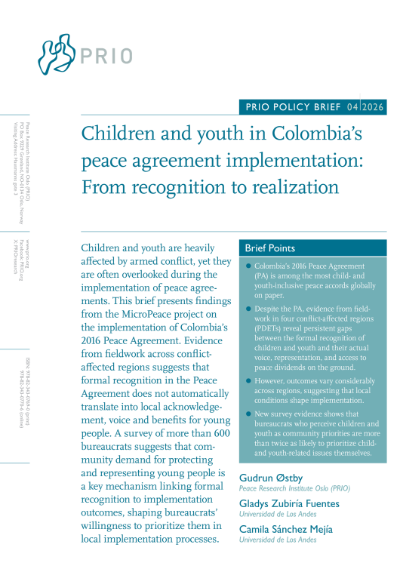
Although Colombia’s peace agreement recognizes children and young people, this does not necessarily translate to effective implementation on the ground. Local action and community support are crucial to ensuring they are included in building lasting peace.
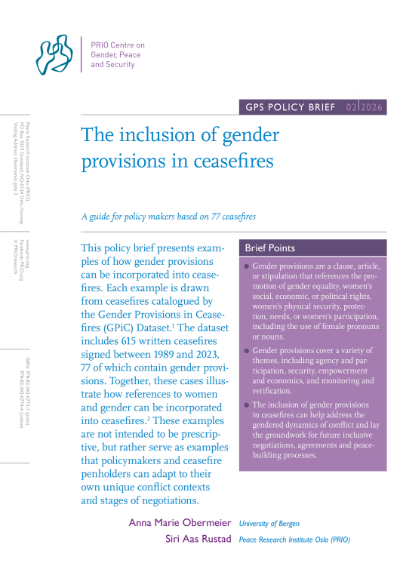
Drawing on 77 ceasefires, this policy brief shows how gender provisions can strengthen ceasefire implementation, protect civilians and support women's participation in peace processes.
The article introduces the first disaggregated global dataset on security force disloyalty during protest and conflict campaigns, showing that also smaller loyalty shifts can be critical to movement success.
This journal article finds that AI can improve food-security early warning, but should complement rather than replace human expertise to avoid potentially costly errors.
This study finds that Morocco chose a giant solar project over smaller local systems because it suited existing energy interests and attracted foreign funding. It argues that political and economic considerations, more than ideology, drove that decision.
This article investigates how Malaysia and Indonesia use discursive strategies on technological neutrality to preserve strategic autonomy amid intensifying US-China competition. Malaysia promotes this approach explicitly while Indonesia embeds it within its long-standing non-aligned foreign policy.