Escalation and the size of wars
Posted Tuesday, 15 Sep 2026 by Aaron Clauset & Kristian Skrede Gleditsch

The war in Ukraine underscores the severe human impact and economic consequences of large wars, but there has been remarkably little attention to why wars differ so much in severity in the first place.
Much of the received wisdom about large wars and variation in war sizes is also questionable. It is often assumed that large wars must have inherently different causes than smaller wars, for example, exceptional circumstances or motives such as existential concerns, threats, or national survival. But the proximate triggers of major wars often seem unexceptional. The Crimean War, for example, followed a dispute over who should hold the keys to Church of the Nativity in Bethlehem.
We also know that leaders often fail to correctly anticipate the size of wars when conflicts break out and key decisions are made. Historians emphasize how European leaders during the events leading up to World War I expected a small and limited war — as captured in the catchphrase “it’ll all be over by Christmas”. Russia likely anticipated quickly seizing much of Ukraine when invading in 2022. But the ability of Ukraine to resist has been far greater than observers anticipated at the time, and the resulting ongoing conflict has now lasted longer than the Soviet Union’s involvement in World War II or World War I. This also contradicts the assumption that large wars should be more likely to end, given the high costs, and as fighting reveals more about the strength and resolve of opponents. These examples highlight the need to better understand how wars evolve.
In a recent article in Science Advances, we argue that there are three possible reasons why some conflicts become large and others not. One alternative is that the large conflicts start out with more intense fighting. A second alternative is that severe conflicts last longer and accumulate more casualties over time. The third alternative is for wars to become large through escalation, or growth in intensity over time. Our article shows that the first two explanations fail, and only escalation dynamics can produce a sufficient proportion of large wars and a distribution of war size matching the observed variation.
Our analysis is based on observed data on the size of wars and simulated data from alternative experiments. Previous work on the severity of conflict has primarily looked at the final size or cumulative casualties at the end of wars. We use data on war sizes measured by battle deaths in conflict from the Peace Research Institute Oslo that also allow us to consider variation across years within conflicts. Final war severity can be counted as a sum of annual severities, but can also be represented by initial severity in the first year and a series of subsequent escalation factors, with either relative increases or decreases from one year to next. We find that these escalation factors have a symmetric distribution, with no general tendency for annual war severity to systematically increase or decrease. But the distribution has extreme variance and very wide tails, reflecting a substantial likelihood of major change, and an uncomfortably high likelihood that conflict severity could increase by a factor of 10 or more. A visual display of this is found in the figures at the end of this text.
We can use the distribution of war sizes and escalation factors to consider the three alternative mechanisms in the dynamics of conflict. If large conflicts start out as more severe or just last longer, then we should be able to reproduce the observed war size distribution by multiplying initial severity by conflict duration. However, we show in the article how initial severity and duration are not closely related to final conflict size, and simulated war size data from a no escalation model cannot reproduce the observed distribution. Models with escalation, however, allow us to reproduce similar war size distributions. We also use the framework to consider more formally differences between types of war, including the apparent ceiling to the escalation of civil wars beyond certain limits, compared to the unconstrained escalation of interstate wars.
Our analyses are based on historical data on wars, simple experiments, and simulations of wars sizes – can this provide useful insights about future conflicts or the risk of escalation in current conflicts and crises? On the one hand, the symmetric distribution of escalation factors means that escalation and deescalation is equally likely, and the wide variance underscores the uncertainty and unpredictability of how individual wars evolve. Forecasts will have very broad size ranges, spanning more than an order of magnitude in total battle deaths, and amplify uncertainty. This is consistent with the role of “fog” in war stressed by von Clausewitz, and should be kept in mind when experts offer overconfident predictions about future war outcomes.
Going beyond the analyses reported in our article, many recent and potential conflicts entail clear risks of escalation and war expansion. Odd Arne Westad’s recen book The Coming Storm: Power, Conflict, and Warnings from History discusses worrying parallels between run-up to World War I and the contemporary era. For example, many foreign actors intervened in the Syrian civil war, and events such as Turkish forces shooting down a Russian warplane in 2015 could have triggered escalation. Russia has repeatedly threatened with nuclear escalation if NATO were to overstep red lines in support for Ukraine after the 2022 invasion. The US-Israeli attacks on Iran have triggered retaliatory attacks on various Gulf states, who in turn have threated further reprisals. Crises over contentious issues such as China’s claims on Taiwan carry a risk of armed clashes between major powers. Some worry that Russia and China may take advantage of depleted missile stockpiles after the clashes with Iran to test the resolve of the US and NATO.
But on the other hand, awareness of the risks of escalation and uncertainty in conflict can also help deter or induce caution. Westad stresses how World War I resulted in part because leaders failed to see the risk of escalation. The fact so many contemporary crises and conflicts do not escalate despite risks may perhaps offer hope that actors have a greater appreciation of the dangers of escalation. The mathematician Lewis Fry Richardson offered a mathematical model of arms races as “merely a description of what people would do if they did not stop to think”. Wars and escalation reflect decisions and choices. We should encourage efforts to prevent wars from breaking out in the first place and limit the risk of escalation in ongoing conflicts.
Figures
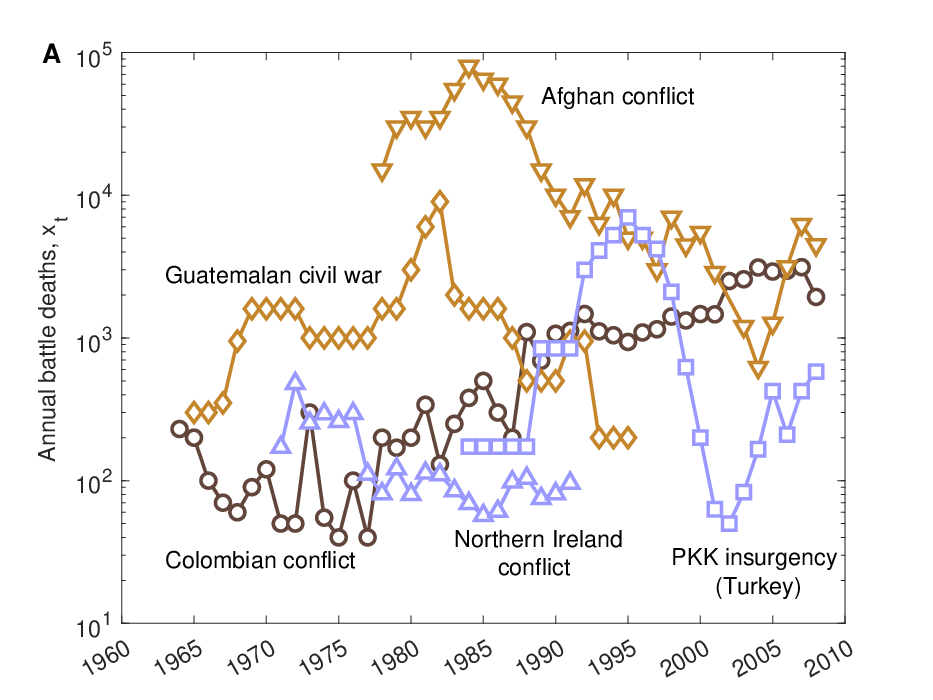
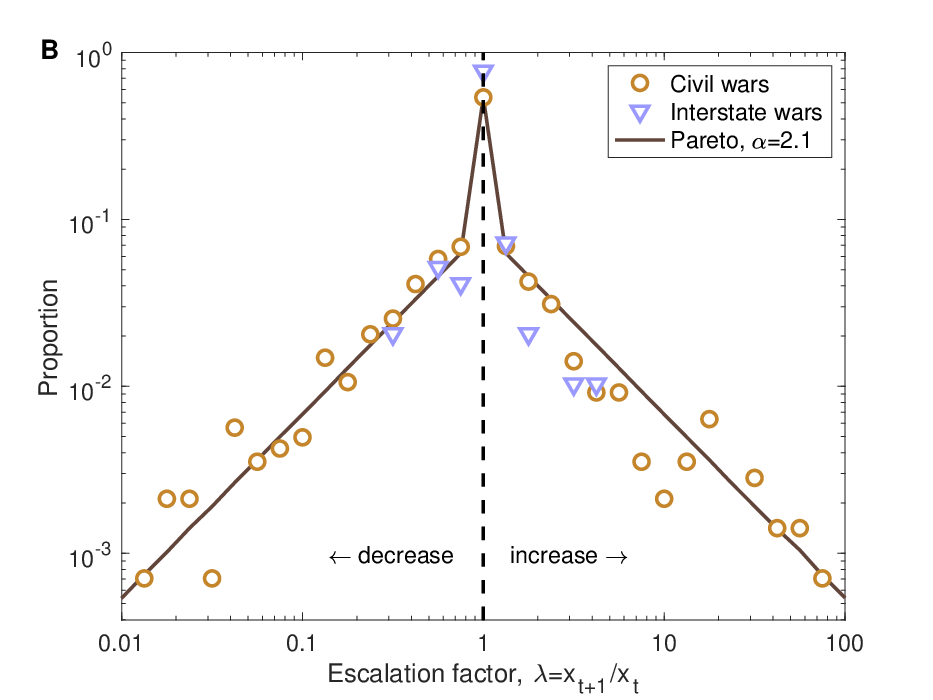
Figures: Civil war severity dynamics. (top, A) Severity time series xₜ for five selected civil war conflicts, showing highly variable periods of escalation and deescalation in annual battle deaths xₜ over time. (bottom, B) Distribution of escalation factors Pr(λ), where λₜ = xₜ₊₁/xₜ, which defines the likelihood of a conflict increasing, or decreasing, its annual severity by a factor λ in the next year, for both civil wars (circles; n_λ = 1415, from 188 conflicts with T>1) and interstate wars (triangles; n_λ = 97, from 18 conflicts with T>1) since 1946, along with a double Pareto distribution with parameter α̂ = 2.0 ± 0.1.
The authors
- Aaron Clauset is a Professor of Computer Science at the University of Colorado Boulder and in the BioFrontiers Institute. He is also External Faculty at the Santa Fe Institute.
- Kristian Skrede Gleditsch is the Regius Professor of Political Science in the Department of Government at the University of Essex, director of the Michael Nicholson Centre for Conflict and Cooperation, and a research associate at the Peace Research Institute Oslo (PRIO).