Russia remains absorbed with Europe amid BRICS summit
Posted Thursday, 17 Sep 2026 by Pavel K. Baev

Russian state media regularly presents the Shanghai Cooperation Organization (SCO) and BRICS as embodiments of a multipolar world order replacing Western dominance (TASS, September 7). [1]
The 18th BRICS summit in New Delhi on September 12–13 was supposed to give a new impetus to this trend, which Russia claims to drive by rejecting the constraints of the Western-led world order. India invested great effort in organizing the summit, which yielded a joint declaration despite differences between many of the ten member states, particularly Iran and the United Arab Emirates (UAE) (Rossiiskaya Gazeta, September 10). Russia sticks out among BRICS members because of its protracted and escalating confrontation with the West. Most other participants—with the obvious exception of Iran—and guests, such as Kazakhstan or Vietnam, seek to cultivate profitable cooperation with the United States and European Union.
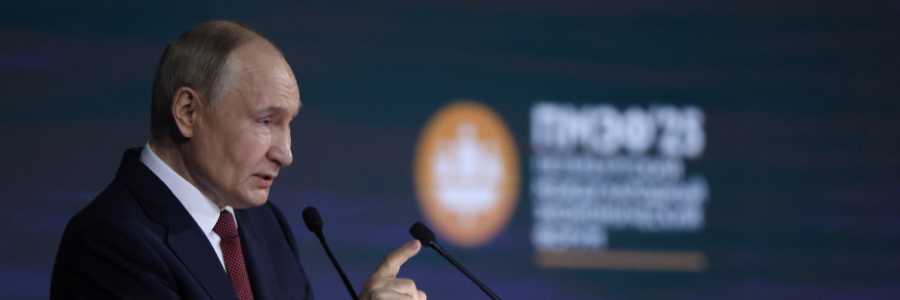
Russian President Vladimir Putin stayed in New Delhi for three days and held many bilateral meetings (Izvestiya, September 12). Putin and General Secretary of the Chinese Communist Party Xi Jinping did not have a face-to-face conversation during the BRICS summit, though they met on August 31 at the SCO summit. In Putin’s presentation, he compared the growing strength of BRICS with the “declining” and “not so big” Group of Seven (G7), which, in his view, wrongfully still tries to present itself as a “blossoming garden” surrounded by “wild jungle” (RBC, September 12).
Russia’s influence on the international arena has shrunk considerably since its full-scale invasion of Ukraine in 2022 (Novaya Gazeta Europe, September 7). Russia’s economic decline is accelerating this decrease in global influence. Its prospects were aptly summarized by a recent headline in Kommersant, a mainstream Russian newspaper, “Less growth, more inflation” (Kommersant, September 3). Kremlin-produced economic statistics are increasingly classified and doctored, but the crisis of state finances is too deep to hide. The Kremlin’s retreat from its earlier effort to contain war expenditures is likely to grow the budget deficit (Nezavisimaya Gazeta, September 9). The government struggles with diminishing returns from increased taxation, but insists that a shift to stricter economic mobilization is unnecessary (The Moscow Times, September 11). Russia’s only hope, which paradoxically is the main worry for other BRICS members, is a spike in oil prices the spread of attacks on tankers from the Strait of Hormuz to the Bab al-Mandab Strait have caused (Novaya Gazeta Europe, September 12). This hope is being curtailed by the sustained Ukrainian campaign of long-distance drone strikes on crucial assets in Russia’s energy infrastructure, which has caused a fall in Russian oil production for the past nine months (Forbes.ua, September 10). Accumulating damage to refineries is driving Russian petrol prices up. The Central Bank of the Russian Federation is keeping the key interest rate as high as 14 percent, though this policy is unlikely to fully contain Russian inflation (The Bell, September 10).
Putin tries to present the reorientation of Russia’s foreign trade away from the European Union as proof of its new engagement with BRICS and other partners from the so-called Global South. The departure of Western investors and the interruption of technological ties with European partners, however, remain one of the core problems for Russia’s industries (Carnegie Politika, September 3). This irreducible economic pain keeps Putin obsessed with Europe (Kommersant, September 11). When asked a question about elections in Saxony-Anhalt, Germany, Putin launched a long speech accusing Europe of making mistakes in cutting ties with Russia and “fanning” the idea of a Russian threat, which, according to Putin, never existed (Meduza, September 12). His denials of plans to escalate confrontation with the European Union stand in stark contrast with the proven increase in Russian sabotage over recent months. On September 12, explosions at an ammunition storage facility operated by the Bulgarian company EMCO, which supplies munitions used by Ukraine, prompted an investigation into possible sabotage and raised suspicions of Kremlin involvement given Russian links to previous attacks on the company’s facilities (Radio Svoboda, September 12).
Putin asserted that a deployment of European troops in Ukraine would constitute war with Russia during his BRICS speech (KP.RU, September 12). He has resorted to direct threats many times, for instance promising a forceful response to seizures of the shadow fleet tankers, which has deterred neither European operations nor Ukrainian strikes. Most recently, on September 10, Ukrainian forces struck the Russian oil tanker Armada Leader in the Black Sea near Sochi (The Moscow Times, September 12).
Many of Putin’s new threats and hybrid attacks focus on the fast-progressing integration of the Ukrainian defense industries into European rearmament programs (Nezavisimaya Gazeta, September 10). This innovation-focused cooperation has grown Ukraine’s capacity to limit Russia’s high-casualty attacks, particularly in the Lyman direction of Donbas (TopWar.ru, September 13). Ukraine’s current key task is to develop and mass-produce a new generation of interceptors that could neutralize the new jet-propelled models of Russian drones (Geran-5), and deny Russia the edge its command expects to exploit in strikes on Kyiv (Re: Russia, September 10).
Moscow sees Ukraine’s capacity to defend and strike back as entirely dependent upon European engagement. Any potential deduction from European support for Ukraine, whether caused by an explosion (fortunately, prevented) in Leipzig or voting in Magdeburg, is of greater importance for Putin than trade tariffs, regulation of the artificial intelligence race, reform of the UN Security Council, or any other item on the BRICS agenda. India, the People’s Republic of China, and most other state-signatories to the New Delhi declaration—which does not mention Russia’s war against Ukraine—are aware, and wary, of this obsession.
- BRICS is a loose political-economic grouping originally comprised of Brazil, Russia, India, the PRC, and South Africa, but now comprising 11 member states (BRICS Info, accessed September 9).
- Pavel K Baev is a Research Professor at PRIO
- This Comment is also published by Eurasia Daily Monitor
Related comments