Predicting conflict fatalities with temporal fusion transformers
Posted Monday, 21 Sep 2026 by Julian Walterskirchen, Christian Oswald, Sonja Häffner & Marco Binetti

Introducing a performant, yet interpretable deep learning algorithm for conflict forecasting.
Can we predict the next escalation of violence?
Conflict is one of the leading drivers of humanitarian crises worldwide. It contributes to displacement, economic collapse, and food insecurity, with an estimated 70% of global hunger linked to conflict and violence.
Preventing conflict altogether is often extremely difficult. However, early warning systems have become an increasingly important part of how governments and humanitarian actors think about conflict and its societal impacts in recent years. Hence, improving forecasts on where and when violence will occur can support anticipatory action: helping governments and humanitarian organizations prepare earlier, allocate resources faster, and mitigate some of the harm experienced by civilians in affected areas. In practice, prediction is messy. Conflicts do not unfold in neat patterns. They can be shaped simultaneously by shifting political dynamics, local and ethnic grievances, environmental pressures, and chance, among other factors.
A new paper introduces a deep learning tool that attempts to address three persistent challenges in conflict forecasting: how to model temporal patterns more effectively, how to quantify uncertainty around predictions, and how to make complex machine-learning models more interpretable. Forecasts on conflict fatalities are useful, but only if they tell policymakers and practitioners not just where violence may increase, but also why, when, and how uncertain the forecast is.
Beyond “black box” predictions
Over the past decade, machine learning has improved our ability to forecast conflict. But this progress has come with a trade-off: the most accurate models are often the hardest to interpret.
For policymakers, this is a problem. A prediction that violence will increase is useful, but only if we have some idea why. Understanding which factors influence a forecast can make these systems more transparent and support their adoption in operational and policy settings.
The approach presented in this paper, using a so-called Temporal Fusion Transformer, tries to bridge this gap. It combines strong predictive performance with tools that allow researchers to look inside the model and trace what drives its forecasts.
Taking time seriously
What sets this model apart is its focus on time. Rather than treating conflict as a static outcome, it learns from how violence evolves: how past events shape future risks, how patterns repeat over months or years, and how sudden shocks can disrupt those patterns.
It can also incorporate information about known future inputs: anticipated events that may influence the likelihood of violence, such as elections, religious celebrations, and recurring social events. This ability to combine past dynamics with known future events reflects a simple but sometimes overlooked point: conflict is not just about conditions, but about timing.
Not one future, but many
Another key contribution is how the model deals with uncertainty. Instead of producing a single point estimate, it generates a range of plausible outcomes, which allows us to ask not only what is most likely, but also how likely extreme scenarios are. This aligns with a broader shift in the conflict forecasting field, where the recent VIEWS Prediction Competition has explicitly emphasized the importance of probabilistic predictions.
Even unlikely escalations can carry enormous humanitarian costs once they materialize. Consider the example of Sudan. The country was already fragile, but few expected the fighting between the Rapid Support Forces and the regular army to escalate so quickly and on such a devastating scale. A system capable of detecting a low-probability but high-impact scenario could have helped actors prepare earlier and potentially reduce some of the harm that followed. In that sense, the model aligns more closely with how risk is understood in practice: not as a single number, but as a distribution of possibilities.
What matters most?
One of the more reassuring findings is that the model does not rely on obscure or unexpected signals. Consistent with previous research, the strongest predictors of future violence are recent conflict events and fatalities, political and institutional conditions, and broader structural factors, including resource pressures. The figure below shows the importance of variable groups by forecast horizon.
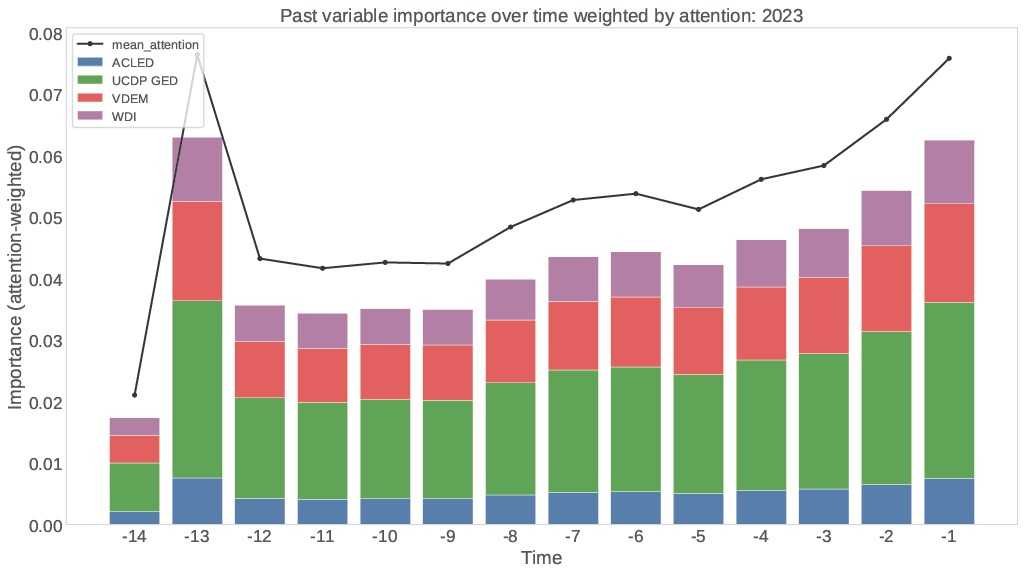
Note: Bars are scaled by attention. The difference between mean attention and bars is due to only including features from the four main data sources.
At the same time, the model also highlights less obvious influences, such as environmental indicators, which can interact with political dynamics to shape conflict risk. Importantly, it does not just identify which factors matter, but also when they matter. Recent developments tend to carry the greatest weight, but longer-term patterns can re-emerge in meaningful ways.
A step forward, though not a silver bullet
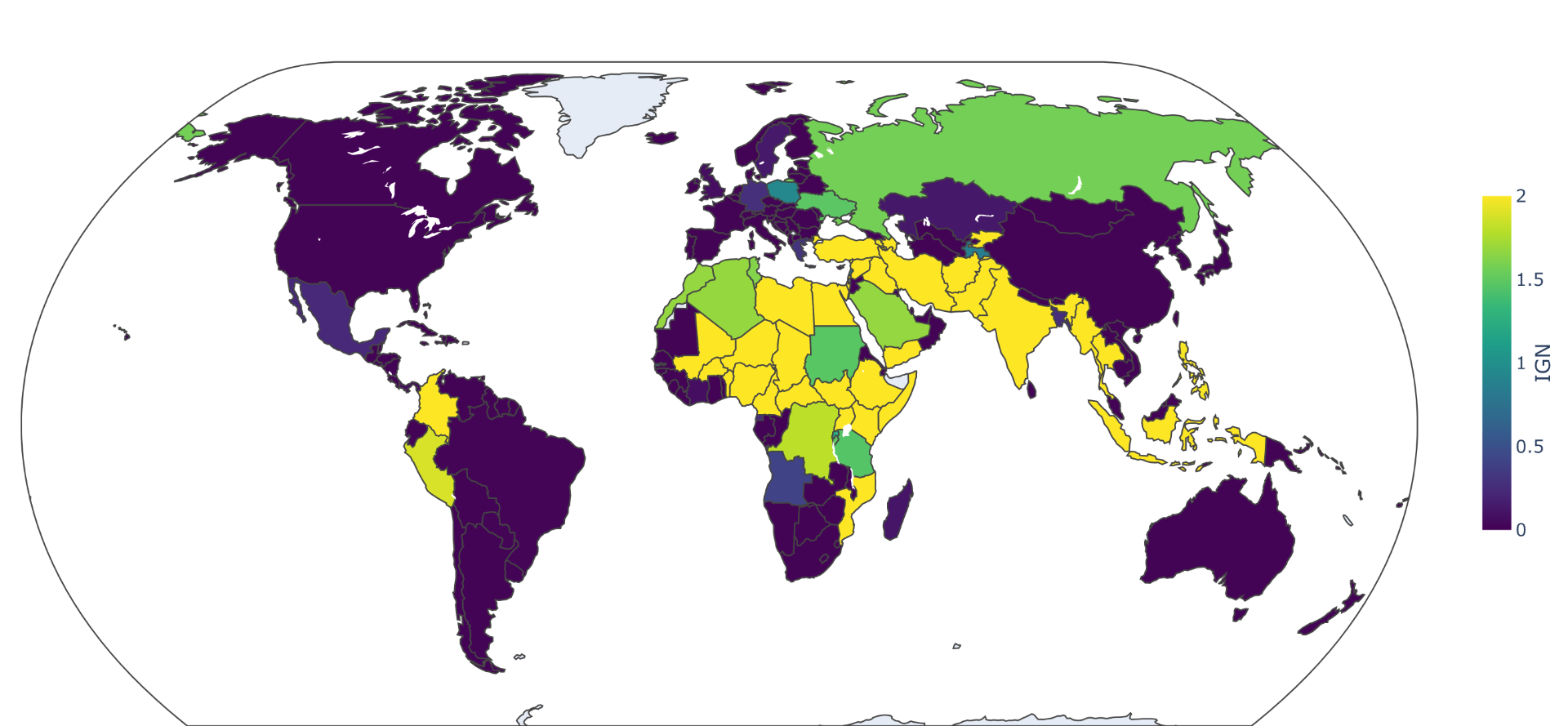
When tested against competing forecasting models, the approach performs consistently well, particularly at the country level. It also provides more informative estimates by combining accuracy with uncertainty. The figure below illustrates forecasts for 2021 evaluated against the Ignorance Score, which indicates how much on target a predictive distribution was, i.e. how concentrated the distribution is around the true value and if high probability densities, as opposed to a uniform distribution, exist.
However, the gains are not dramatic across all settings. And, like any model, it depends on the quality of the underlying data. This is a reminder that better algorithms alone will not solve the challenge of conflict prediction. Progress will also depend on improving data quality, refining theory, and understanding how forecasts are actually used.
More broadly, advances like this are cumulative. They are based on a growing ecosystem of data, benchmarks, and existing models. Efforts such as shared prediction tasks and open evaluation frameworks have enabled systematically comparing approaches and continuously increasing performance. In that sense, the contribution here is less a standalone breakthrough than a part of a collective process of incremental improvement.
From prediction to anticipatory action
Ultimately, the value of conflict forecasting lies not in the predictions themselves but in what follows from them. Models like the temporal fusion transformer and others can help identify where risks are rising, what factors may be driving them, and how confident we should be in those assessments. But they cannot decide what could or should be done. That remains a political question.
What they can do, however, is help governments and humanitarian actors make more informed decisions about how to allocate resources, complementing qualitative analysis and contextual knowledge, and perhaps, in some cases, enabling action earlier rather than later. This is not the result of any single model, but of a broader collaborative effort between researchers and institutions to improve how risks are measured and communicated.
The authors
- Julian Walterskirchen, Department of Political Science, University of Gothenburg.
- Christian Oswald, Center for Crisis Early Warning, University of the Bundeswehr Munich.
- Sonja Häffner, Peace Research Institute Oslo (PRIO).
- Marco Nicola Binetti, Institute of Intercultural and International Studies, University of Bremen.

Related topics
ForecastingAll tags