Survey evidence from King Harald V’s funeral: those Norwegians who felt their grief was shared grew closer to the nation
Posted Monday, 19 Oct 2026 by Júlia Palik & Robert Jagiello

In this blogpost, we share preliminary findings from our pre-registered survey of Norwegians, conducted before and after King Harald V’s funeral.
We asked whether people felt more deeply connected to the nation before and after, and whether this made them more trusting and cooperative toward each other. This matters beyond the funeral itself. Norway’s preparedness strategy relies on a society whose members trust and help one another in a crisis.
But how is that kind of social cohesion built, and what strengthens it? The funeral gave us a rare chance to find out. You can find more information about the survey at the end of the blogpost.
Key takeaways
- During the mourning period, many Norwegians already felt a visceral sense of oneness with the nation (what social psychologists call identity fusion), and the funeral did not raise it further on average.
- Yet, beneath that average many individuals still reported being more or less fused with Norway. It was the sharing of the experience that made the difference. Fusion grew among those who felt their grief was shared with other Norwegians.
- How people followed the funeral mattered. Live viewers became more united in grief and stayed fused with the nation, while fusion declined among those who did not watch live.
- Fusion went hand in hand with trust. Where fusion increased, so did trust in fellow Norwegians and a sense of national unity, both key resources in a crisis.
- We also discuss how admiration for the late King is related to fusion, and what our results mean for preparedness.
Why do funerals matter?
Funerals are amongst the oldest and universally practiced rituals. They help individuals to process their grief and provide occasions for strengthening group ties in times of transition. Funerals have been empirically shown to influence people’s attitudes and behaviour: Participation in Queen Elizabeth’s funeral was associated with a visceral sense of oneness with a group, what social psychologists call identity fusion, a construct that predicts cohesion, trust, and sacrifice for a group. Another study found that mourners who endured more discomfort queuing to see Pope Francis's body gave more to a Catholic charity but not to a neutral one, showing that enduring the physically costly funeral ritual was associated with generosity toward one's own group. A study conducted in Kenya found that people who engaged in more traditional mourning rituals had more prosocial attitudes. Together, these studies suggest that funerals matter not only for individual grief but for group life. We set out to examine this by tracking how Norwegians' fusion, trust, and generosity changed around King Harald's funeral.
What we did
In contrast to prior work, we surveyed the same people twice: before the funeral, on 3 September 2026 during the mourning period and on 10 September, the day after the funeral.Through YouGov, we reached 1,007 adults, weighted to be representative of Norway's population by age, gender, region and education, and 854 of them answered both surveys (1). Each time, we asked:
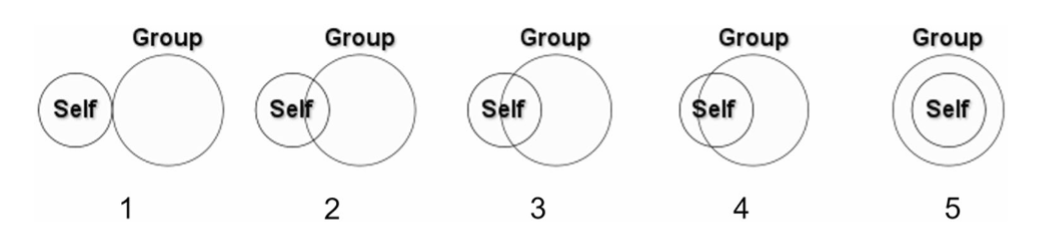
- how fused they are with Norway, using the pictorial fusion scale (see Figure 1.)
- how sad they felt
- whether they felt other Norwegians were grieving with them;
- how much they trust other Norwegians,
- how united they think the country is;
- how much of an imaginary 1,000 kroner they would give to a charity helping fellow Norwegians.
The first survey also asked how much they admired the King, and the second asked how they followed the funeral: in person, live on TV or online, afterwards, or not at all. Because we heard from the same people before and after, we could track how each person's answers changed rather than just taking a snapshot. Since no one could be randomly assigned to watch the funeral or not, our findings show what goes together, not what causes what.
What we found
Fusion
We found that in the days after the King's death, before the funeral, many Norwegians already felt a visceral sense of oneness with the nation. This likely explains why the funeral did not raise it further on average. In our first survey, fielded during the mourning period, four in ten respondents chose the picture showing themselves entirely inside Norway. After the funeral, this was virtually unchanged (40% before, 39% after) (2). Because we have no measurement from before the King's death, we cannot say whether mourning raised fusion or whether it was this high all along. What we can say is that the funeral itself did not add to it on average. This matters: the study of Queen Elizabeth II's funeral found a similar link between shared grief and fusion but measured it only after the ceremony. Our before-and-after design shows the bond was already there beforehand, so funerals may be less a source of national bonds than events that enable the expression of such strong relations amongst individuals who do not know each other.
Shared grief
What mattered for change in fusion was how people experienced their grief. Fusion rose among those who agreed that "people in Norway were united in grief with me," and among those who felt their pain was about the same as other Norwegians' (3). On average, respondents described their sadness as only slightly intense, and how sad someone felt during the funeral was not reliably linked to changes in fusion. Instead, grief, it seems, binds when it is felt to be shared.
Mode of funeral attendance
How people followed the funeral also made a difference. In the second wave we asked each person how they had followed it, live (in person, on TV, or online), only afterwards, or not at all, and we then compared their answers to the other questions across the two waves. Those who had watched live showed a larger increase in feeling united in grief than those who only caught up afterwards. Among live viewers, the share who were fully fused with Norway stayed about the same across the two waves (43% before the funeral, 44% after). Among those who did not watch live, it fell (34% before, 30% after). Live viewers chose to watch and were already more fused beforehand. We therefore see this as a promising lead rather than a firm conclusion: live participation may help hold the bond in place rather than create it.
Admiration for the King
Before launching the study, we hypothesized that who dies matters for the outcomes we study. Admiration for the King was the strongest predictor (4) of fusion we measured before the funeral. It did not, however, determine who became more or less fused across the funeral: admirers were strongly fused before and stayed so after.
Trust and cooperation
Finally, fusion was not merely a private feeling but went hand in hand with how people saw their fellow citizens. Respondents whose fusion rose across the funeral also reported more trust in other Norwegians and a stronger sense that Norway is more united than divided (5). These links were modest, but they held when we used people's answers in the first survey to predict their answers in the second. These findings are striking in a country that already sits at the very top of European trust rankings, a pattern scholars call "Nordic exceptionalism". Even from that high a starting point, Norwegians who became more fused trusted one another more. People who felt more fused also said they would give more to a charity helping fellow Norwegians (6). However, how fused someone felt in the first survey did not predict their giving in the second, so this link is weaker than the one for trust.
Taken together, the funeral did not further strengthen the national bond on average, most likely because the bond was already strong when we first measured it, after the King's death but before the funeral. Since we have no measure from before his death, this does not mean that the death and mourning left fusion unchanged. They may well have raised it, but our data cannot show this. What mattered for who grew closer to the nation was not the ceremony as such, nor the intensity of sadness, but the feeling of grieving together. This fits research showing that shared painful experiences, such as combat, terrorist attacks or natural disasters, can forge fusion even without a formal ritual. Because we surveyed the same people twice, our comparisons are made within each person, so stable differences between individuals, such as personality or political views, cannot explain the changes we see. And because we asked people both before and after the funeral, we avoid a classic chicken-and-egg problem: we can see that the funeral came first, and any shift in people’s views came afterwards. This makes our design considerably stronger than a typical one-off survey, although events other than the funeral between the two waves could still have played a role.
What our findings mean for Norway’s total preparedness policy
Measuring fusion is not a mere academic exercise. Fusion has crucial consequences for groups. A recent paper examining 90 studies shows that fusion predicts costly pro-group action, such as willingness to fight and die for the group, cooperation, or donation. As the opening paragraph of Norway’s Total Preparedness strategy states: “Norway is a long country, but we are bound by strong ties. We live across the length and breadth of the country and we have a fundamental trust in each other and in the authorities. This community of trust and good, safe and vibrant local communities throughout the country are the most important building blocks of Norwegian civil preparedness.” Identity fusion can be understood as a psychological building block of relations between humans. If relations are strong, people can effectively cooperate to achieve a goal, in this case the protection of the country. The strategy appears to treat trust and close social ties as given and constant, but they might change over time with potentially influential downstream effects. And while we detected no average change in fusion across the two waves, our data shows that more than four in ten respondents (373 of 854) placed themselves differently after the funeral. Those who moved into full fusion (87) were almost exactly balanced by those who moved out of it (94). In short, fusion can change over time, as shown by others too. Taking these psychological dynamics into account could make preparedness policy more attentive to how social ties are built and maintained, making the defense strategy truly people centered.
Notes
- The retention rate was 85%; an attrition analysis showed that returning and non-returning respondents did not differ on the study's main measures, including identity fusion.
- The stable average hides a lot of movement, however. More than four in ten respondents (373 of 854) placed themselves differently after the funeral. Those who moved into full fusion (87) were almost exactly balanced by those who moved out of it (94).
- Felt unity in grief (agreement that "people in Norway are united in grief with me") was positively associated with fusion (p < .001). Perceived emotional sharedness (feeling one's own pain is about the same as other Norwegians') was likewise positively associated (p = .003). Sadness intensity showed no reliable association (p = .20).
- Admiration for the King predicted fusion both directly and indirectly through unity in grief (p < .001).
- A greater increase in fusion was associated with higher trust in other Norwegians (p < .001) and with higher perceived national unity (p < .001).
- The pro-group giving question was formulated for both waves as “Imagine you were given 1,000 kr. How much of it, if any, would you give to a charity helping other Norwegians in need? You keep whatever you do not give. Response: Any amount from 0 kr to 1,000 kr
About the survey
We conducted a two-wave, within-person panel design. The same nationally weighted sample of Norwegian adults was surveyed twice through a YouGov omnibus: Wave 1 (N=1007) shortly before the funeral of King Harald V (fielded 3 September 2026; the funeral is on 9 September 2026) and Wave 2 shortly after (fielded 10 September 2026) recontacting the same respondents ( N=854). The funeral was a naturally occurring, non-repeatable event experienced by all respondents. The primary comparisons are within-person changes from Wave 1 to Wave 2, supplemented by moderation analyses using individual differences measured within the panel (e.g. attachment to the King, and mode of engagement with the funeral). The English and Norwegian versions of the questionnaire and our pre-registered design can be accessed through this link. All analyses presented here are preliminary. The final results will be reported in a forthcoming academic article. We are grateful to PRIO’s leadership for providing funding for this study and enabling its implementation under extreme time pressure. Similarly, we would like to acknowledge the invaluable help of Per Ståle Ekrol and Jane Hansen for facilitating the inclusion of our survey questions into YouGov’s Omnibus. We further thank Henrikas Bartusevičius, Harvey Whitehouse, Ilze Gehe, Siri Aas Rustad, Michelle Delaney, and Haakon Gjerløw for providing feedback and support for our study.
The authors Júlia Palik and Robert Jagiello are both Senior Researchers at PRIO.
Related comments