Echoes of Partition: Migration, borders and shared humanity
Posted Friday, 14 Aug 2026 by Marta Bivand Erdal

Mid-August marks the independence of India and Pakistan in 1947, but also the mass migration and violence that followed in the wake of Partition. Approximately 14 million people moved—or were forced to move—across the newly drawn borders.
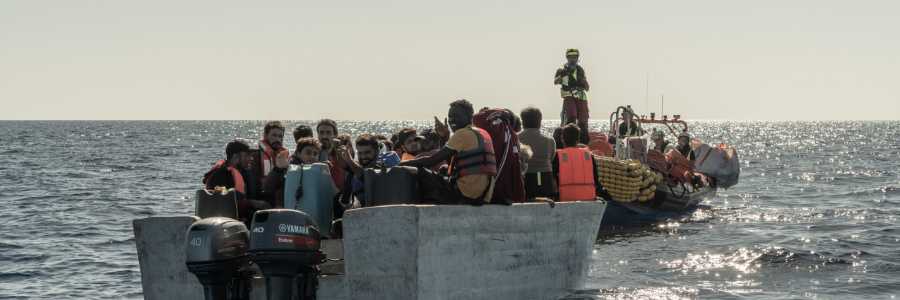
Today’s news cycle is dominated by debates over border control following the events in Ceuta and by the new regional defense pact between Pakistan, Turkey, and Saudi Arabia. Such issues might seem far removed from the history of 1947.
That is not necessarily the case. They touch on many similar issues regarding borders, mobility, security, and belonging.
Setting aside today’s geopolitical conflicts, it is worth turning our attention to the history that shaped the events of 1947 and the surrounding decades. Two recent books examine and reinterpret 20th-century South Asian history, shedding light on both the past and on important global issues of today. They also invite us to look beyond the framework of the nation-state and explore how people, places, and political communities are interconnected over time.
In an era marked by increasing polarization and exclusionary forms of nationalism, the experience of living together across differences—as revealed, perhaps surprisingly, through historical narratives—deserves closer attention. Precisely because these specific stories unfold amidst extreme political turmoil and violence, they highlight the agency of ordinary people—their choices, relationships, and hopes for peaceful coexistence. This adds nuance to notions of identity and belonging that can easily appear more clear-cut than they actually are.
Sam Dalrymple's Shattered Lands: Five Partitions and the Making of Modern Asia invites readers to see the Partition of India not as a single event in 1947, but as one of five major territorial and political ruptures that dissolved the British Indian Empire between 1937 and 1971. These included the separation of Burma (Myanmar) and Aden in 1937, the secession of the Gulf protectorates from 1947 onwards, the Partition of India and Pakistan in 1947 (including the integration of more than 550 princely states), and the secession of Bangladesh from Pakistan in 1971. Together, these processes transformed a single territorial entity into the twelve states that today are India, Pakistan, Bangladesh, Myanmar, Nepal, Bhutan, Yemen, Oman, the United Arab Emirates, Qatar, Bahrain and Kuwait.
This perspective highlights connections that existed before the borders were fixed. Drawing on archival material and oral testimonies, with a primary focus on political developments, Dalrymple depicts how both the empire and its people moved, traded and lived in a region stretching from the Red Sea to Southeast Asia. He shows, among other things, how the connections between India, Aden and the areas around the Persian Gulf were well-established through labour migration, trade and the administrative structures of the empire. The author also shares a fascinating reflection – the enormous oil resources were known, but the areas in which they were located were poor – it is therefore challenging to imagine that anyone in the 1930s could have fully imagined the extent of the income that the Gulf states would accumulate in the coming century.
The end of the empire not only created new states, but also changed patterns of trade, travel routes and infrastructure. One example is the separation of Burma in 1937, which illustrates how political border demarcations could change the conditions for people who lived and worked across what had previously been a common geographical and administrative area. But we also see how the creation of new borders could mean displacement and loss for those caught up in the political upheavals. The book points out that the history of division and fragmentation that has shaped modern South Asia is also a history of what were once intertwined lives and worlds, across linguistic and religious differences – and many kinds of hierarchies.
While Dalrymple examines how borders and nation-states were created in a broad regional perspective, Mishal Husain’s Broken Threads: My Family from Empire to Independence looks at how these upheavals were experienced and lived on in families’ memories.
Drawing on letters, documents, written memories, and extensive family research, Husain reconstructs lives shaped by the fall of the British Empire and newfound independence. At the center are her four grandparents: her maternal parents, Shahid Hamid and Tahirah Butt, whose lives unfolded in political, administrative, and military environments in Delhi and northern India before 1947. And her paternal parents, Mumtaz Husain and Mary Quinn, who linked Multan in Punjab with the Anglo-Indian environments of southeast India through a marriage across religious divides, between a Muslim man and a woman of Irish-Catholic and Hindu background. They met in Lahore in 1940, when she was a nursing student and he a medical student, and married in 1942 in two separate Muslim and Catholic ceremonies. Their story illustrates how family life and personal relationships could cross religious and social categories, albeit with resistance from family members and others, but none the less.
Husain describes how the upheavals of the 1940s and the creation of Pakistan were experienced in cities like Delhi, Lahore and Multan, where political change intertwined with family loyalties, migration, faith and loss. Her grandmother, Tahirah Hamid, was probably saved when she was evacuated from Shimla to Lahore in 1947 in a British private plane provided by a field marshal. She was originally supposed to travel by train, but the violence along the railway lines during Partition made such travel extremely dangerous. The flight probably saved her and her children from the fate that befell many train passengers during the bloody migrations between India and Pakistan.
The book also follows the family's life in Pakistan, after independence, which was marked by the uncertainty of state-building. We read about Mumtaz, the author's grandfather, who, after arriving in Rawalpindi in 1947, was among those who tried to prevent the looting of houses that had been abandoned by Hindus and Sikhs who had fled east. This proved to be to no avail. Simultaneously, his wife, the Catholic Mary, who had moved with her Muslim husband to Rawalpindi, tried to find a foothold in a new society, through active involvement in the life of the local Catholic school.
The mass migrations and new borders did not break all connections. Contact with relatives who remained in India continued through visits, although after a few years these became difficult and soon almost impossible. But correspondence within family networks continued, and grandparents sent pictures of their grandchildren so that aunts and uncles knew about them – even if they could not meet. While Partition created new borders and political divides, many, like Husain’s family, did not break all the social and familial ties that existed before 1947. Later migration of family members to Britain added a new layer to these stories that linked South Asia with its diaspora – also as a long shadow of the British Empire.
The approaches of Dalrymple and Husain are different but complementary. Where Dalrymple shows how new borders, states and regional power relations emerged from the dissolution of empire, Husain traces how the same processes were experienced in her family. Together, the books illustrate the relationship between political structures and people's everyday lives: how decisions about territory, citizenship, and security have consequences far beyond those who make the decisions – and with major ripple effects decades later.
A geographical perspective helps to hold different scales together: from families and communities to states and empires, and back again. This makes it possible to see connections that often disappear when history is viewed through the prism of one state at a time. Even when conflict and violence dominate, as they did in 1947, the relationships and shared experiences that bind people together do not disappear. And their traces cannot easily be subsumed within politicized dividing lines.
Almost eighty years after 1947, several themes are recognizable, both in and outside South Asia. Historical narratives like these can expand our understanding of both the world and our own place in it. The books do not offer simple answers to complex issues. But they can remind us of something that is easily lost in polarized debates: that people’s lives are always woven into larger political and historical processes, but that these processes are themselves shaped by relationships, experiences, and choices.
Taken together, these books invite a more nuanced understanding of the partitions of the British Indian Empire and its aftermath. Perhaps such a perspective can also contribute to a degree of historical humility.
- Marta Bivand Erdal is a Research Professor in Migration Studies at the Peace Research Institute Oslo (PRIO) and Co-lead of the PRIO Migration Centre
Related comments