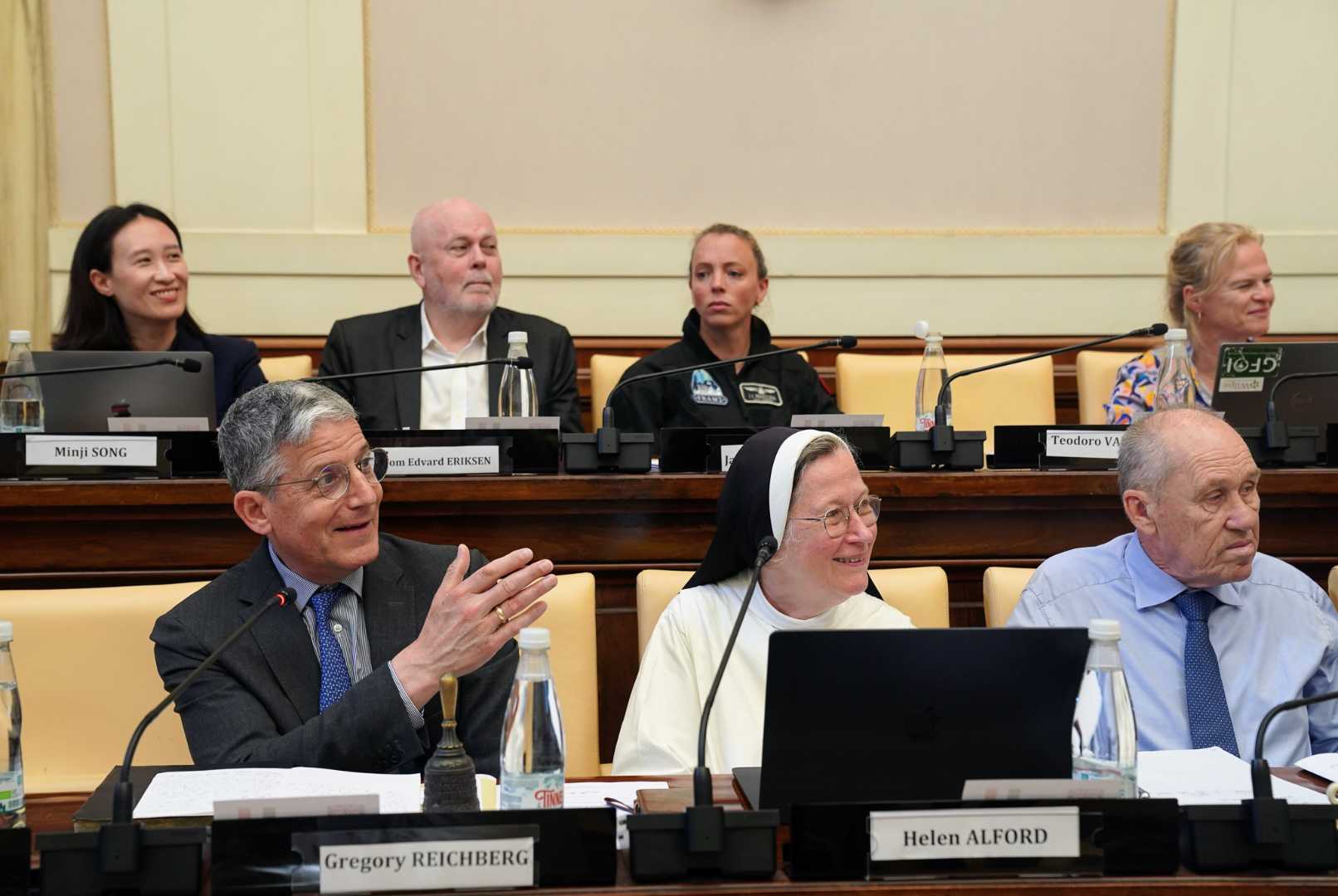
The idea that satellites can help build peace is no longer a distant vision. In July, PRIO brought together leading voices from the humanitarian, diplomatic, scientific and space communities for the conference "Satellites for Peace: An idea whose time has come," organized in partnership with the Institute for Economics and Peace, Kongsberg Satellite Services, the United Nations Development Programme, and the United Nations Satellite Centre.
The conference was organized under the auspices of the Pontifical Academy of Social Sciences at the Vatican. PRIO thanks the Academy for making possible this groundbreaking conference.
PRIO's Greg Reichberg co-chaired the conference with Sister Helen Alford, President of the Academy of Social Sciences. Giacomo Bruni, Andreas Forø Tollefsen, Henrik Syse and Chandler Williams participated in panels alongside an impressive group of humanitarian actors, government and UN representatives, space industry leaders and scholars from around the world.
The global space industry – revenues valued at $630 billion in 2023 and projected to reach $1.8 trillion by 2035 – has rapidly expanded around the deployment of low-earth-orbit satellites. These systems now underpin essential civilian applications: scientific research, communications, navigation, and earth observation. Satellite imagery is indispensable for monitoring agriculture, climate, deforestation, water resources, urbanization, and poverty – capabilities central to food security, environmental stewardship, sustainable development, and effective aid delivery. For fragile and conflict-affected areas, the role of satellites is even more crucial. Remote sensing provides accurate and timely information that ground personnel often cannot safely collect.
Space is also a unique arena for collaboration, guided by the visions and promises of the Outer Space Treaty of 1967, and inspired by the hundreds of astronauts who, from the beginning of the Space Age, have witnessed the impact of seeing Earth from the outside. We were privileged to have one such astronaut with us: Norwegian Jannicke Mikkelsen, who shared her experience of the “Overview Effect” – seeing our planet from space – as a contribution to peace. Following that, the participants shared and discussed the technological and diplomatic possibilities and challenges of utilizing satellite data for peace.
The conference title echoes a 1979 Washington Post article inspired by Senator Adlai Stevenson, who envisioned satellites serving peace and human progress. Nearly fifty years later, this vision is no longer aspirational: global sharing of satellite imagery has advanced dramatically in reach, resolution, and analytical value. Yet Very High Resolution (VHR) imagery (<50 cm) remains dominated by military demand, limiting access for humanitarian actors who urgently require these data to document crises, support vulnerable populations, and counter misinformation. The latest PRIO Conflict Trends report notes a record 65 armed conflicts in 35 countries in 2025. Effective humanitarian action now depends on reliable, high-resolution observations that only satellites can provide. Realizing this potential requires stronger cooperation among governments, the private sector, and the scientific community. In an increasingly polarized world, satellite data sharing offers a rare avenue for constructive, cross-bloc collaboration. The conference accordingly explored the potential of utilizing satellite imagery and analysis for our human good, as well as examining the ethical challenges of data sharing and the importance of close collaboration with communities on the ground.
PRIO will now, following upon this conference, take part in a process towards utilizing current resources and competencies by creating an alliance framework that can serve as a knowledge and fundraising hub to strengthen commitments from stakeholders.