Search for autocad 2020 serial number
Displaying results 1 to 30 of 2169 for autocad 2020 serial number

Tuesday, 21 Apr 2026
Applications open for the 2026 Barcelona Summer School of the Mediterranean and the Middle East
The Barcelona Summer School of the Mediterranean and the Middle East is a joint initiative co-organized by IBEI, Catalonia International and IEMed.
The ceasefire with Iran expires on 22 April. What happens then?
The crucial question remains unanswered: What has actually been achieved politically?
It’s time for academics to take community action on AI
The situation is critical – Academic publishing urgently needs life support.
Political realism in the era of Donald Trump
Donald Trump’s behaviour lies far outside the bounds of traditional political realism, making it challenging both to conduct and to interpret international politics and diplomacy in the era of Trump.
Deadlocked war subtly changes to Russia’s detriment
This year’s 32-hour-long Easter truce for Russia’s war against Ukraine did not lead to a lasting ceasefire nor a resumption in peace talks.
Journal Article
The underreported death toll of wars: a probabilistic reassessment from a survey with UCDP coders
Journal article in Journal of Conflict Resolution
Lebanon in the crossfire: Ten key points about the impact of the US-Israeli war on Iran
Lebanese resilience is being tested in a population worn down by conflict, once again caught in the crossfire of regional rivalries.
Peace with an entry fee: Trump’s Board of Peace as a blueprint for ending wars
Talk of peace and war has been prevalent of late. In the last few weeks, President Trump’s Board of Peace met for the first time, tasked with securing peace amidst ongoing violence in Gaza.
Russia struggles to find a response to U.S.–Israel attack on Iran
The U.S.–Israeli airstrikes against Iran that began on February 28 shocked Moscow.
Wellbeing of women goes hand in hand with wellbeing of nations
In 2024, 676 million women lived in proximity to conflict, that is almost every 6th woman in the world — the highest number and proportion ever recorded.
What problems are third‑country asylum centres intended to solve?
The EU is considering moving parts of asylum processing out of Europe, and several countries are pushing for third-country solutions.
Trump’s attention-grabbing tactics
With a keystroke, the Trump administration shifted the world’s attention onto something that didn’t happen. At the same time, the most serious abuses happened absent our attention.
Venezuela: Bombs and sanctions – the humanitarian consequences
It is high time for the international and Norwegian media to focus on the humanitarian consequences of the U.S attack and sanctions on Venezuela, and on Machado’s shared responsibility for them.
‘Energy truce’ could be preamble to Ukraine peace deal
In the January 30 “energy truce” Russia and Ukraine agreed to halt strikes on energy infrastructure until at least February 1.
Assad’s fall gave hope, but the future hangs by a thin thread
Just over a year has passed since Assad’s brutal dictatorship fell and millions of Syrians regained hope. But with faltering support for refugees and reconstruction, and fears of new conflicts, hope is wearing thin.

Monday, 5 Jan 2026
PRIO secures new funding for research on conflict, gender, security and human resilience
PRIO has recently secured several external research grants, highlighting strong confidence in the Institute’s research and its relevance to pressing global challenges.
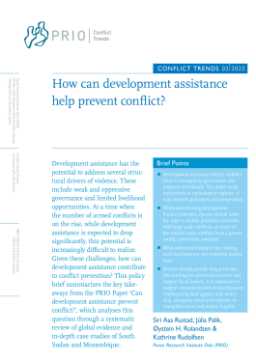
Policy Brief
How can development assistance help prevent conflict?
Conflict Trends
Thursday, 18 Dec 2025
Top 5 most-read PRIO policy briefs in 2025
The most-read PRIO policy briefs of 2025 covered key global conflict issues including Gaza’s humanitarian crisis, women’s exposure to violence, ethical challenges in peace processes and resource stress in fragile regions.
Where is civilian drone research going?
The future of civilian drones is not predetermined. It will emerge through dialogue among researchers, regulators, industry, security actors and civil society.

Wednesday, 10 Dec 2025
AI model warns of deadliest conflict zones in 2026
Ukraine, Palestine/Israel, Sudan, Pakistan and Nigeria are projected to see the highest battle-related death tolls in 2026, according to a world-leading AI-driven conflict forecasting system.
Peace and good institutions save lives from floods
Why do some countries succeed in minimising the human toll of floods, while others face repeated catastrophes? The answer lies not only in meteorological or economic conditions, but also in political ones.
Flaws in Putin’s art of no-deal for peace become apparent
In November, a 28-point U.S.–Russia draft peace proposal was leaked that heavily favored Moscow, sparking backlash from Ukraine and the European Union.
What are duties good for? Lessons from the pandemic
The concept of duty can be clarifying of social and political relations.
Commanding change: What can we learn from the Swedish Armed Forces’ leadership program on gender equality?
What can we learn from senior military leaders on how to create sustainable organizational capacity building and improved recruitment and retention of personnel by better considering gender equality?
Aeropeace in airspace: from defensive measures to positive peace
Peace can no longer be imagined without a peaceful sky – without ‘Aeropeace’ – but what does that entail?
Thursday, 13 Nov 2025
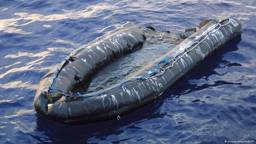
Interview with Maria Gabrielsen Jumbert on Humanitarian Negotiations in the Mediterranean Sea
In this interview, Senior Researcher Maria Gabrielsen Jumbert talks about her case study on humanitarian negotiations in the Mediterranean Sea. This study is a part of the PRIO project Red Lines and Grey Zones. The interview was conducted by Sunni...
Preparing for the wrong war? The need to broaden the focus beyond defence spending towards a comprehensive approach to peace and security
Europe is rearming. What are the likely consequences of this strategy?
Putin’s elites could become proponents of peace
Generational and social divisions shape elite attitudes toward Moscow’s war, with mid-level security operatives enforcing loyalty to Russian President Vladimir Putin and younger privileged figures largely indifferent to patriotism but obedient to ...
Policy Brief
Children affected by armed conflict, 1990–2024
Conflict Trends
Record high: One in five children in conflict zones
From Gaza to Sudan to Ukraine, the headlines keep reminding us of a painful truth: children are always among the hardest hit during conflict and war.
Result type